

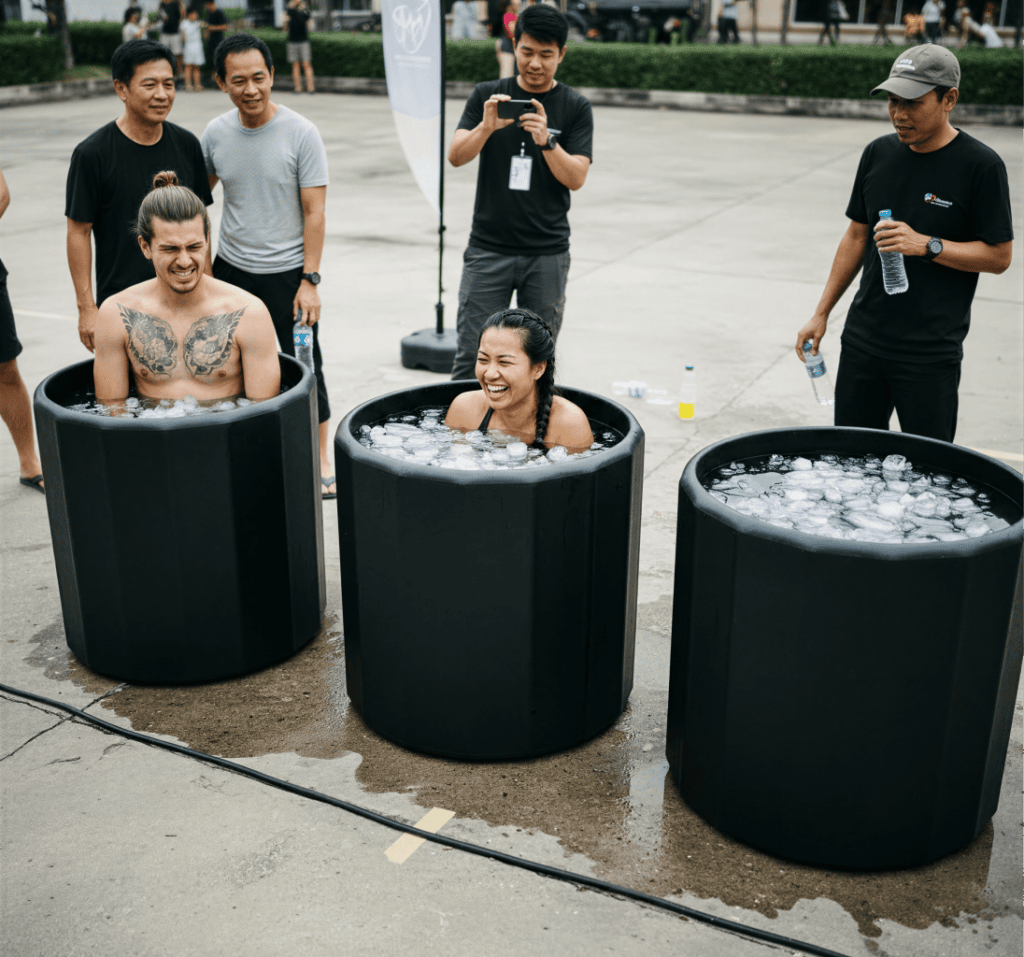
I started cold plunging in an inflatable. Most people do.
Mine was a black drop-stitch tub on the concrete out the back, filled with tap water and bags of ice I drove to the shop to buy. It worked. I got in, I hated the first forty seconds, and I got the recovery I was after. For the first few months, it did everything I needed it to do.
Then the questions began. Customers kept asking: “Should I just get the cheap inflatable one, or spend more on a proper steel tub?” My honest answer was always longer than they expected. The truth is, there’s no single right choice for everyone. It depends on where you live, how you’ll use it, how long you want it to last, and how much sun it will get in Thailand.
So here’s the full story, with no sales pitch. I sell both types, and I’ll explain when each one makes sense, what the trade-offs are, and which one I’d recommend to my own family.
What’s the actual difference between an inflatable and a permanent ice bath?
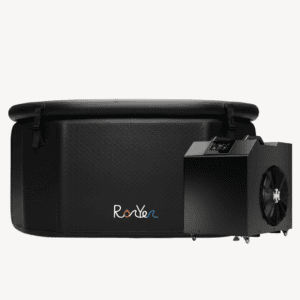
An inflatable ice bath is a soft-sided tub made from thick, multi-layer PVC with a drop-stitch core, just like stand-up paddleboards and rescue boats. You use a pump to inflate it, fill it with water, and you’re ready to plunge in about fifteen minutes. When you’re finished, you can deflate it and pack it away.
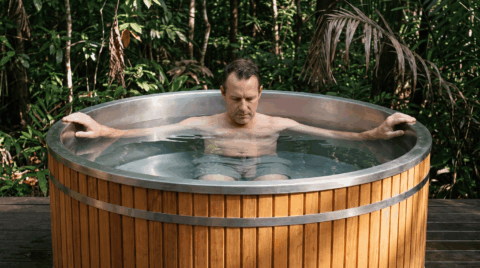
A permanent ice bath is a hard tub that stays in one spot. Ours are made from 304 or 316 stainless steel, and some models have Red Cedar on the outside. It doesn’t fold or pack away. It’s a fixed part of your home, like a bathtub or a small pool.
Both serve the same main purpose: holding cold water for you to get in. The differences are in everything else—how long they last, how well they keep the water cold, running costs, appearance, and how easy they are to live with every day.
Here’s the simplest way to look at it. An inflatable is like heavy-duty camping gear—light, portable, and quick to set up or take down. A permanent tub is more like furniture: solid, fixed, and built to last for years.
How long does an inflatable ice bath last in Thailand?
This is the main reason I tell most serious cold plungers to think twice before choosing an inflatable as a long-term solution.
A good inflatable ice bath, looked after well, lasts a few years. The cold plunge industry generally puts inflatable and PVC tubs at around two to five years of life with proper care (PolarMonkeys, “Inflatable vs Hard Shell Cold Plunge,” 2026). Hard-shell tubs are commonly rated at ten to twenty years (TubWars, “Inflatable vs Hard-Shell Hot Tubs,” 2025). That’s a real gap, and in Thailand it gets wider.
Here’s why. The real problem for PVC isn’t cold water—it’s the sun and heat. Ultraviolet light breaks down PVC over time, making it brittle and likely to crack. Standard PVC can start to show visible damage within six to twelve months of direct sun, with serious brittleness developing in the years after (BASTONE, “Is PVC UV Resistant?”, 2026).
The tropical sun is much harsher. Industry tests show that PVC ages 30 to 50 percent faster in tropical regions than in cooler ones. High surface temperatures make this worse—the oxidation rate of PVC roughly quadruples for every 10°C increase (pvctarpaulin.com, “How Long Does PVC Tarpaulin Last in Sunlight?”, 2025). Inflatable boat makers see the same issue: a PVC boat that lasts five to ten years in a cool climate may only last about two years in the tropics if left uncovered (Perun Outdoors, “How Long Do PVC Inflatable Boats Last?”). A black tub in a Thai courtyard faces exactly this problem.
None of this means an inflatable is useless. It just means you need to take care of it in Thailand: keep it shaded, use the cover, and don’t leave it in the sun all day. Even with good care, you’ll get a few years out of it, not a decade. A stainless steel tub doesn’t have these issues. Steel isn’t affected by UV, resists corrosion and impact, and a good one is truly a buy-it-once item (Soundhon, “Stainless Steel vs Inflatable Cold Plunge,” 2025).
Does an inflatable ice bath stay cold in the Thai heat?
Not as well, and this is where you end up spending more money than you might expect.
Inflatable tubs have thinner walls and less insulation than solid tubs. In a cool climate, this isn’t a big deal. But in Thailand, where the air is often above 30°C, it makes a big difference. The water in an inflatable warms up faster, so you either use more ice to reach your target temperature or, if you have a chiller, the chiller has to work harder to keep it cold.
That second point is the hidden cost. A chiller with a poorly insulated inflatable can work two to three times harder to keep the same temperature as it would with an insulated tub (Soundhon, 2025). Over a month, this means a higher electricity bill, more noise from a compressor that runs more often, and more wear on the chiller, which can shorten its life. A permanent tub with thicker, insulated walls keeps the cold longer and lets the chiller turn off more often, making it quieter, cheaper to run, and easier on the equipment (PolarMonkeys, 2026).
If you use bagged ice and don’t have a chiller, the lack of insulation means your water stays cold for a shorter time and you’ll make more trips to buy ice. Either way, the lower upfront price of an inflatable comes with higher running costs in a hot climate. It’s better to know this before you buy.
Is a permanent ice bath more comfortable?
Mostly, yes, but it’s not a clear win for the permanent tub. The inflatable has its own advantages too.
A permanent stainless tub has a solid, planted feel. You climb in and out against a rigid edge, the shape holds, and the better models have ergonomic interiors and proper seating. Reviewers consistently rate hard tubs higher for the secure, sturdy in-and-out experience (Cold Plunge Reviews, “Inflatable vs Hard Shell Cold Tubs,” 2024).
But the inflatable has a real comfort advantage: the walls are soft. The air-filled sides give your neck and back something gentle to lean against, which is easier than resting your head on cold steel for three minutes. For some people, especially those using cold therapy for rehab or injury recovery, that soft surface is a real benefit and makes getting in and out easier (Huale, “Inflatable Ice Bath vs Framed Ice Tub,” 2025).
So, permanent tubs are better for solidity and seating, while inflatables are better for softness. It depends on what feels best for your body.
Is a permanent ice bath more hygienic?
Yes, and this is especially important in a humid country like Thailand.
Stainless steel is used in medical facilities for a reason—it’s non-porous, easy to clean, and resists the build-up that softer materials can collect (Soundhon, 2025). A hard tub is also easier to drain, wipe down, and use with proper filtration. Inflatables can be kept clean, but their seams, folds, and softer surfaces need more attention. In Thailand’s humidity, anything that traps moisture needs extra care. If you want low-maintenance hygiene, a permanent tub is the easier choice (Cold Plunge Reviews, 2024).
What about portability and space?
This is where the inflatable really shines, and it’s the clear winner.
If you rent, live in a condo, don’t have a permanent spot, or want to pack it away when guests come over, the inflatable is the obvious choice. It weighs about 20 to 25kg with accessories, deflates to the size of a large suitcase, and fits in your car if you move (RecoveryGuru, “Best Ice Baths for Home Use,” 2026). A permanent stainless tub can’t do any of that. Once it’s installed, it stays put.
There’s also the “test the waters” argument, which makes sense. If you’re not sure cold plunging will become a habit, an inflatable is a low-commitment way to try it. Many people in the industry suggest this approach: prove the habit to yourself first, and if you’re plunging five mornings a week after two months, you’ll know if it’s time to upgrade (Eternal Ice Bath, “Inflatable or Hard Cold Plunge for Daily Use,” 2026).
So which one should you buy?
Here’s how I actually talk people through it.
Buy an inflatable if:
- You rent or live in a condo with no permanent space.
- You want to test whether cold plunging is for you before spending more.
- You need to move it, store it, or take it with you.
- Your budget right now is the deciding factor.
- You’ll keep it shaded and covered, not baking in the sun.
Buy a permanent ice bath if:
- You’ve got a fixed spot for it, and you’re committed to the habit.
- You want it to last ten years or more, not a few.
- You’re running a chiller and want lower running costs and less compressor wear.
- Hygiene and easy maintenance matter to you
- You want it to look like a proper part of your home, not gear.
The honest summary: an inflatable is the gateway. It’s how most people start, it’s how I started, and there’s no shame in it. But if you already know cold therapy is part of your life, a permanent tub costs more up front and saves you money and hassle over the years, it’ll keep going. The cheapest tub isn’t the one with the lowest price — it’s the one you’re still using in five years.
What does each one cost at RönYen?
Prices shown so you can do the maths yourself.
Inflatable range (bath only):
- Inflatable Barrel Ice Bath, 1 person — from ฿19,999
- Inflatable Tub Ice Bath, 1-2 person — from ฿22,999
- Inflatable 4 Person Ice Bath — from ฿31,999
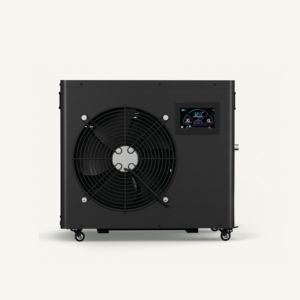
Add the matched chiller to any inflatable: +฿74,000 (barrel and tub) or +฿99,000 (4-person). With the chiller included, the inflatable Barrel is ฿93,999, the Tub is ฿96,999, and the 4-person is ฿130,999.
Permanent range (built to order, 4-6 weeks):
- Black Plunge Ice Bath, 304 stainless steel, 1 person — ฿86,450
- Stainless Steel Ice Bath Tub, 304 stainless, 1 person — ฿94,050
- 3-4 Person Red Cedar & Stainless Steel Ice Bath, 316 stainless — ฿94,050
- Oval Ice Bath, Red Cedar & 304 stainless, 1 person — ฿100,700
- Circular Wood & Stainless Steel Ice Bath, 304 stainless, 1-2 person — ฿108,999
- Wood Plunge Ice Bath with Railing Stairs, Red Cedar & 304 stainless — ฿109,250
- All-in-one Ice Bath, white seamless acrylic with built-in chiller — ฿166,250
- All-in-one Ice Bath & Chiller, Red Cedar & 304 stainless — from ฿173,453
Here’s a number that surprises many people: once you add a chiller to an inflatable, the total is ฿93,999, which is about the same as where permanent stainless tubs start. So if you know you want a chiller, the permanent tub is often the smarter buy from the beginning. It lasts longer, costs less to run, and you’re not spending inflated prices for a steel-tub result.
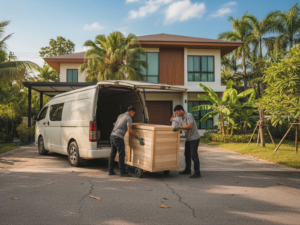
Every tub comes with free delivery Thailand-wide. The permanent tubs are built to order with a 4-6 week build time.
So, what’s better? Inflatable vs Permanent Ice Bath
If you’re trying cold therapy, renting, or short on space, start with an inflatable. Prices begin at ฿19,999, and it will do the job. If you know this is part of your lifestyle, have the space, and especially if you want a chiller, choose a permanent tub. In Thailand’s sun and heat, steel lasts much longer than PVC, costs less to run, and stays cleaner.
Either way, try plunging first and decide later. Both options offer the same benefits. The only difference is how long the tub will keep providing them.
If you need help choosing the right tub size or matching a chiller, that’s what our free consultation is for. We’ll recommend what fits your space and honestly tell you which option suits your needs.
FAQ
Q: How long does an inflatable ice bath last in Thailand?
A: With good care, expect a few years — the industry generally rates inflatable PVC tubs at two to five years (PolarMonkeys, 2026). Thailand’s sun and heat shorten that, because UV radiation and high temperatures break down PVC faster — tropical ageing runs 30 to 50 per cent quicker than in temperate climates. Keeping it shaded and covered makes a real difference. A stainless steel tub isn’t affected by UV and lasts far longer.
Q: Is a permanent ice bath cheaper to run than an inflatable?
A: In a hot climate, yes. An inflatable’s thinner walls hold the cold less well, so a chiller works two to three times harder to maintain temperature, meaning higher electricity costs, more noise, and more wear on the chiller. A permanent insulated tub holds cold longer and lets the chiller cycle off, which is cheaper and quieter day to day.
Q: Can I add a chiller to an inflatable ice bath?
A: Yes. At RönYen, the matched chiller is +฿74,000 for the Barrel and Tub, or +฿99,000 for the 4-person. Worth knowing: once you add the chiller, an inflatable comes to around ฿93,999 — right where the permanent stainless tubs start. If you want a chiller anyway, a permanent tub is often the better-value choice from the outset.
Q: Which is more comfortable, inflatable or permanent?
A: Permanent tubs feel more solid and have proper seating and ergonomics, which most people prefer for everyday use. Inflatables have one advantage: soft, air-filled walls that are gentler on your neck and back, which can suit rehab and injury recovery. It comes down to what your body wants.
Q: I rent and might move — which should I buy?
A: An inflatable. It weighs around 20-25kg, deflates into a suitcase-sized pack, and comes with you when you move. A permanent stainless tub is a fixed installation. If flexibility matters more than longevity, the inflatable is the clear choice.
REFERENCE LINKS
- PolarMonkeys — Inflatable vs Hard Shell Cold Plunge: https://polarmonkeys.com/pages/inflatable-vs-hard-shell
- Soundhon — Stainless Steel vs Inflatable Cold Plunge: https://soundhon.com/information/cold-plunge-guide/stainless-steel-vs-inflatable-cold-plunge-which-is-actually-right-for-you/
- Eternal Ice Bath — Inflatable or Hard Cold Plunge for Daily Use: https://eternalicebath.com/en-us/blogs/cold-plunges-posts/inflatable-or-hard-cold-plunge-daily-use
- Cold Plunge Reviews — Inflatable vs Hard Shell Cold Tubs: https://www.relaxacare.ca/blogs/news/coldure-vs-ice-barrel-inflatable-cold-tubs-vs-hard-shell-cold-tubs-cold-plunge-reviews
- TubWars — Inflatable vs Hard-Shell Hot Tubs: https://tubwars.com/inflatable-vs-hard-shell-hot-tubs-which-wins/
- pvctarpaulin.com — How Long Does PVC Tarpaulin Last in Sunlight (tropical ageing data): https://pvctarpaulin.com/how-long-does-pvc-tarpaulin-last-in-sunlight/
- BASTONE — Is PVC UV Resistant: https://bastone-plastics.com/blogs/is-pvc-uv-resistant-the-surprising-truth-about-sun-damage-and-what-actually-fails/
- Perun Outdoors — How Long Do PVC Inflatable Boats Last: https://perunoutdoors.com/blogs/news/how-long-do-pvc-inflatable-boats-last
- Huale — Inflatable Ice Bath vs Framed Ice Tub: https://huale-inflatable.com/inflatable-ice-bath-tub-vs-framed-ice-tub-the-advantages-of-inflatable-models/
- RecoveryGuru — Best Ice Baths for Home Use in Australia 2026: https://www.recoveryguru.com.au/blog/best-ice-bath-for-home-cold-therapy-recovery/