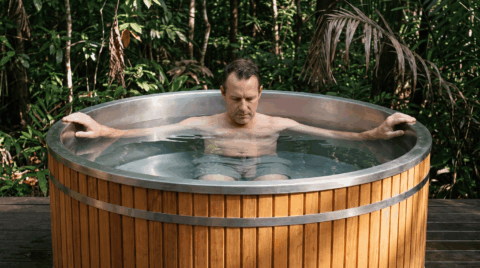
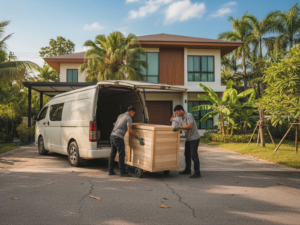

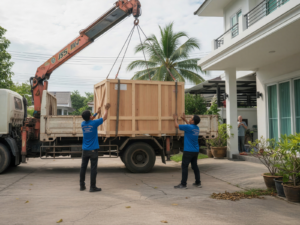

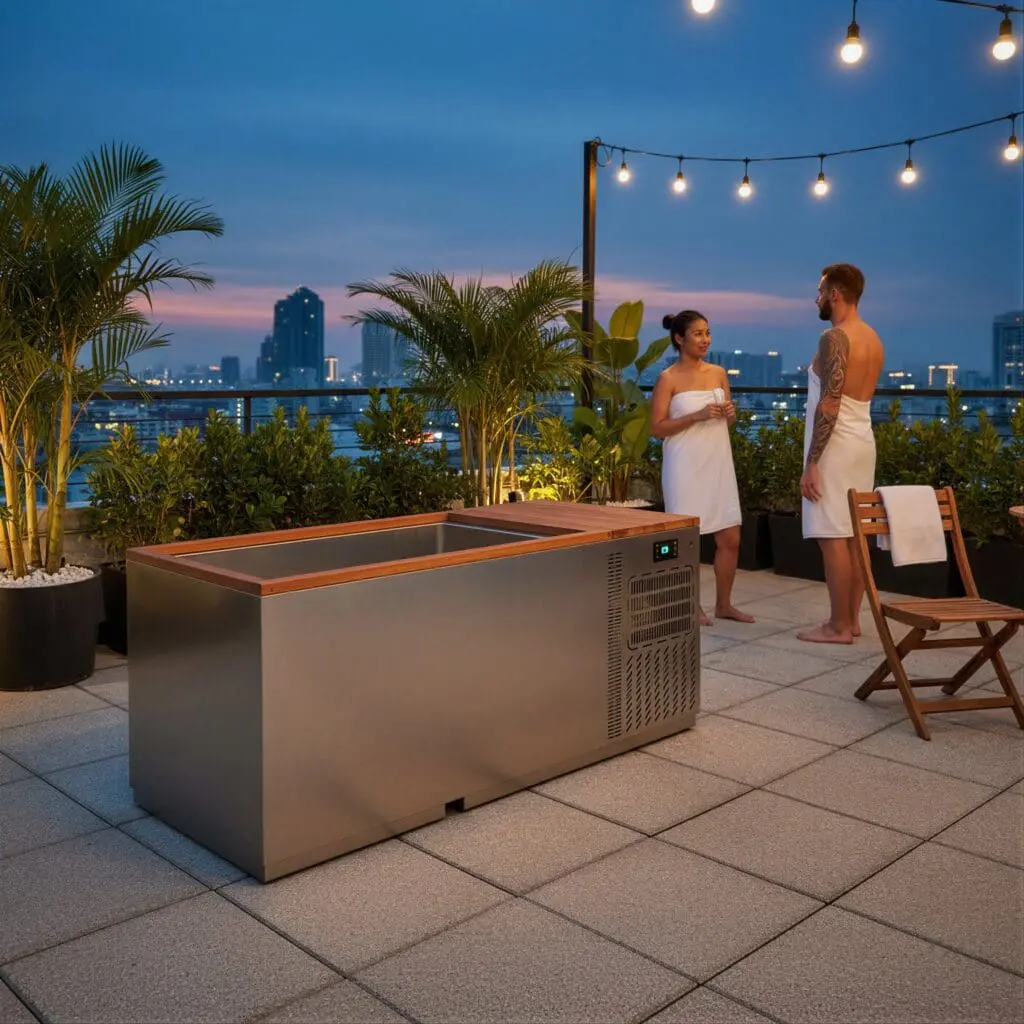
For the first few weeks, I used bagged ice for my ice bath. I drove to the shop, brought the bags home, poured them in, and saw much of the ice melt before I even got changed. By the time I finished, the water was already warming up again. The next morning, it was the same routine: another drive, more bags, and more melting.
Then I sat down and worked out the numbers. This post shares the honest results, so you can decide if you really need a chiller or if ice is enough for you.
How fast does ice melt in an ice bath in Thailand?
Fast. Much faster than anywhere with a real winter.
Tap water here is usually around 28-30°C for most of the year. To make an ice bath effective, you are not just lowering it a few degrees; you need to bring it down by 15 to 20°C, all while the environment is working to heat it back up. The sun hits the tub, the air is 33°C, and the humidity is high. The heat never lets up.
Here’s the basic science: cooling a single-person tub of about 300 litres from 30°C to 10°C takes around 85-90kg of ice, and that only gets you there once. It does not account for keeping the temperature down as the afternoon heat returns. If you stay in for a full session, you will need to add more ice.
With each bag costing ฿15-฿20, it takes nearly ฿500 to cool the tub just once. If you do this every day, you are spending ฿10,000 or more each month, not counting the time and effort involved in buying and carrying the ice. That cost made me reconsider.
How cold does an ice bath actually need to be?
Colder than a cool bath, but not as cold as most people assume.
The research lands on a fairly tight window. A 2025 network meta-analysis in Frontiers in Physiology pooled 55 controlled trials and found that 10 to 15 minutes at 11 to 15°C worked best for easing muscle soreness, while 5 to 10°C was more effective for deeper recovery markers (muscle-damage enzymes and jump performance). A separate systematic review in PLOS One reached the same broad conclusion: cold-water immersion after hard exercise speeds up recovery of physical function, reduces soreness, and lowers post-exercise inflammation.
One honest note: the same research shows that regular cold plunges right after weight training can slow muscle growth over time. If you want to build maximum size and strength, wait a few hours between your workout and your ice bath. For recovery, sleep, and feeling better in this climate, though, ice baths are hard to beat.
Aim for a temperature between 5 and 15°C. In Thailand, the key is to keep the water at that temperature for your whole session, not just reach it briefly before it warms up again.
What does a chiller actually do?
A chiller does two things that ice cannot manage well in this heat: it cools the water and keeps it cold.
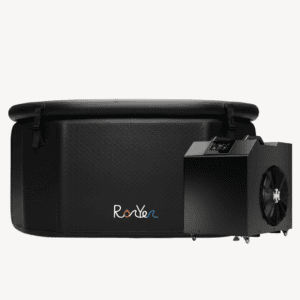
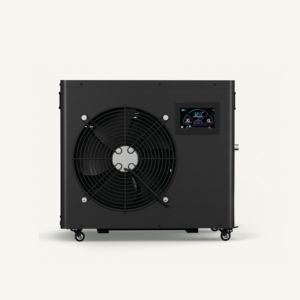
A chiller is a compressor unit that removes heat from the water and circulates it, so your tub stays at the exact temperature you set, like 8°C or 10°C, whether you get in right away or hours later. There are no bags to buy, no trips to the shop, and no guessing. Most chillers also filter the water and often use a UV steriliser, so the water stays clean, and you do not have to drain and refill it every few days. With just ice, the water stays still, warms up, and goes bad quickly.
You set the temperature once and can get in whenever you want. That is the main benefit.
Ice versus a chiller: what does it really cost?
The costs are very different. Ice is cheap at first but expensive over time. A chiller costs more up front but is cheaper in the long run.
Ice: nothing to buy up front since you already have the tub, but roughly ฿300 to ฿500 per session just to get cold, plus top-ups to keep it cold. Used daily, that is, ฿9,000 to ฿15,000 a month, indefinitely.
Chiller: There is a real upfront cost of ฿74,000, plus electricity costs. With Thailand’s current rate of about ฿3.95 per unit, keeping a single tub cold with a chiller costs about ฿400 to ฿700 a month, depending on your chosen temperature and how hot your location is.
You do not need a spreadsheet to see when the costs cross over. If you use an ice bath most days, a chiller pays for itself within a few months and keeps saving you money. Plus, you will no longer have to handle bags of ice.
So do you actually need a chiller?
It really depends on how you use your ice bath. Here is a straightforward breakdown.
You probably do not need a chiller if you plunge a couple of times a week, you do not mind a shop run, and you are happy to get cold for a few minutes rather than maintaining a specific temperature. A bag or two of ice in an inflatable ice bath, from ฿19,999, and you are sorted.
You probably do want a chiller if you use your ice bath every day, want the same temperature each time, share the bath with others at home, in a gym, or in a studio, or if you do not want to keep buying ice once the novelty fades (which is true for most people). A chiller is even more worthwhile when multiple people use the bath, since the filtration keeps the water clean rather than letting it get murky by the end of the week.
This is the main reason RönYen exists: to offer cold therapy that works in Thailand’s heat, instead of struggling with melting ice every day. For some people, a tub and a bag of ice are enough. For most who keep up the habit, a chiller is the better choice.
What size chiller do you need?
It comes down to your tub’s volume, how cold you want to go, and how exposed your spot is.
As a general guide, a 1.5HP chiller unit is good for a single-person tub in a shaded or indoor spot at typical recovery temperatures. Choose a 2.0 HP chiller unit if you have a larger tub, want very cold water, need a quick cooldown, or your bath is in full sun where it gets very hot. If the chiller is too small, it will run constantly and still struggle on the hottest days. If you choose the right size, it will keep your water at the right temperature without using too much power.
If you are unsure, let us know your tub size and where it will be placed, and we will help you choose the right chiller. There is no reason to pay for a bigger compressor than you need.
Frequently Asked Questions
Can’t I just use ice instead of a chiller?
Yes, especially if you only use an ice bath occasionally. The challenge in Thailand is the cost and convenience. It takes about 85-90kg of ice to cool a single tub once, and the heat quickly warms it back up. For daily use, a chiller is cheaper to run and much less trouble.
How cold should I set my chiller?
A range of 5-15°C is supported by research. Most people find 10 to 12°C comfortable and effective to start. You can lower it toward 5°C as you get used to it or if you want deeper recovery.
Does a chiller keep the water clean?
Most chillers do. They move the water through a filter, and many have a UV steriliser, so the water stays clear much longer than in a still tub with melting ice. You will still need to change the water sometimes, but not as often.
How much does a chiller cost to run in Thailand?
It costs about ฿400-฿700 per month to keep a single tub cold, based on Thailand’s current electricity rate of about ฿3.95 per unit. The exact cost depends on your chosen temperature and your location’s heat.
Will cold plunging hurt my gym gains?
The timing is what matters. Regular cold immersion right after weight training can slow muscle growth, so wait a few hours between lifting and your ice bath. For recovery and sleep, the benefits are well supported.
Want to figure out whether ice or a chiller is better for your setup? Send us a message with your tub details, where it is, and how often you plan to use it, and we will give you a clear answer. If this helped, share it with the friend who keeps taking your ice.
Carl runs RönYen Wellness in Chonburi, providing saunas, ice baths, and chillers throughout Thailand and shipping internationally. He has used hot and cold therapy every day for years and learned most of this through experience, often the hard way, one bag of ice at a time.