
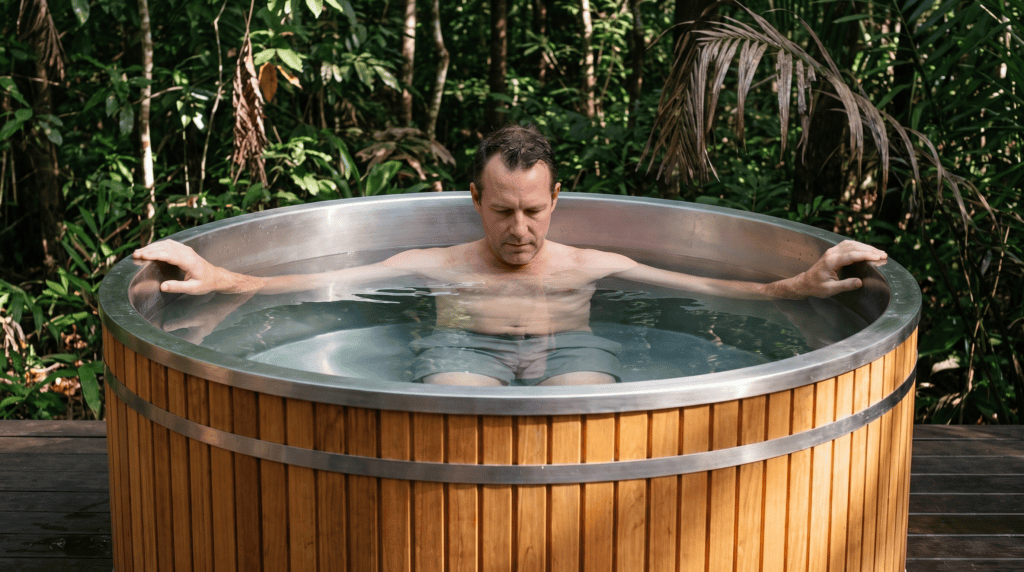
For several years, I’ve been taking cold water baths, and the first thing that no one ever tells you is that Thailand “cheats” [joke]. The tap water stays at about 28 to 30°C year-round; if you fill a bathtub and then walk away, you’ll have a lukewarm bath. So before discussing which ice bath is best, you should realise that in Thailand, the bathtub is only half the deal. The other half is how you get the water cold and keep it that way.
Taking that into account, I’ll now give an honest look at the four types that are actually available for sale here: inflatables, acrylic baths, all-in-one systems, and wooden and stainless steel baths. Although I sell two of these and therefore have a bias, I’ll also tell you exactly when the cheaper options are appropriate.
Are inflatable ice baths worth it?
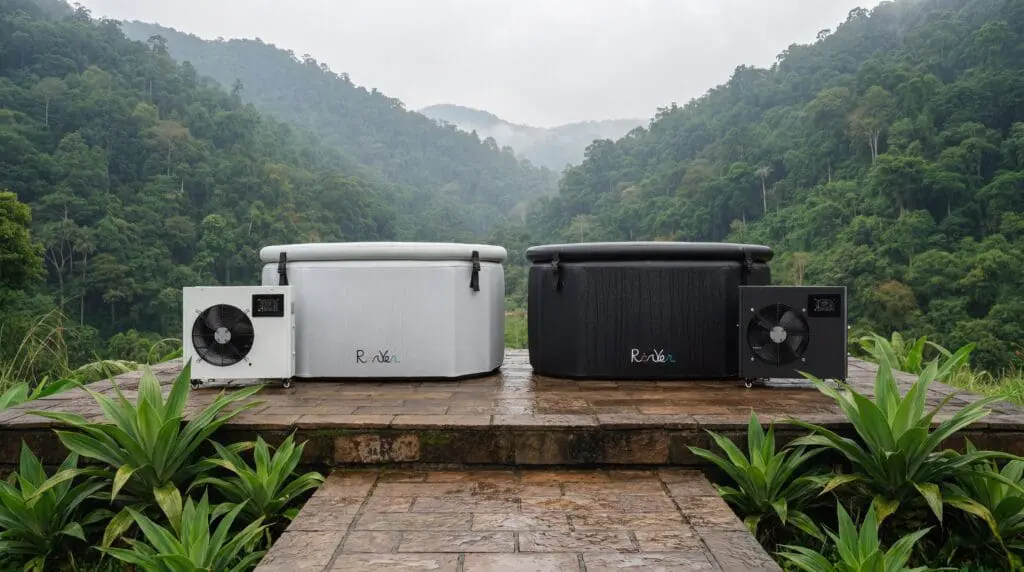
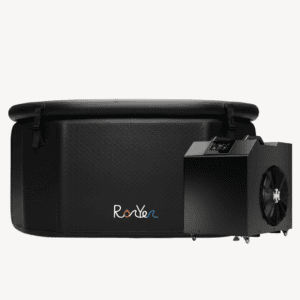
Yes, if you’re looking to begin. An inflatable ice bath is a tub made from PVC or with a drop-stitch construction that fits into a bag, requires no plumbing and can be set up in ten minutes. We carry a two-person model at RonYen, and I always recommend it to people who want to see whether ice plunging is something they’ll genuinely adopt or just a temporary trend before investing any money.
The main disadvantages are that the insulation is thin, so in Thailand’s hot climate your ice will melt quickly, or your chiller will have to work hard. The material breaks down when exposed to UV radiation if it’s going to be used outdoors, so you should find a shaded location. Also, it has the appearance of camping equipment, which is acceptable when placed next to a gym mat but not so appropriate next to a villa pool.
Verdict: it is the best entry point, the best in terms of portability, and has the shortest lifespan.
What about acrylic ice baths?
The acrylic and fibreglass baths are the smooth white ovals that you find in gym recovery areas; they are lightweight, easy to clean and generally fall within the mid-price range.
In Thailand, there are two problems. The first of these is the sun; acrylic turns yellow and becomes brittle when exposed to the tropical ultraviolet radiation, and so an acrylic bath used outdoors ages rapidly if it is not sheltered by solid cover. The second problem is that it scratches, and when acrylic is scratched it holds on to biofilm, meaning that more chemical treatment is needed in order to keep the water safe in a climate in which warm water encourages the growth of organisms.
Verdict: Fine indoors with air conditioning. Not a good choice outside in Thailand.
Should all-in-one ice bath systems be worth the consideration?
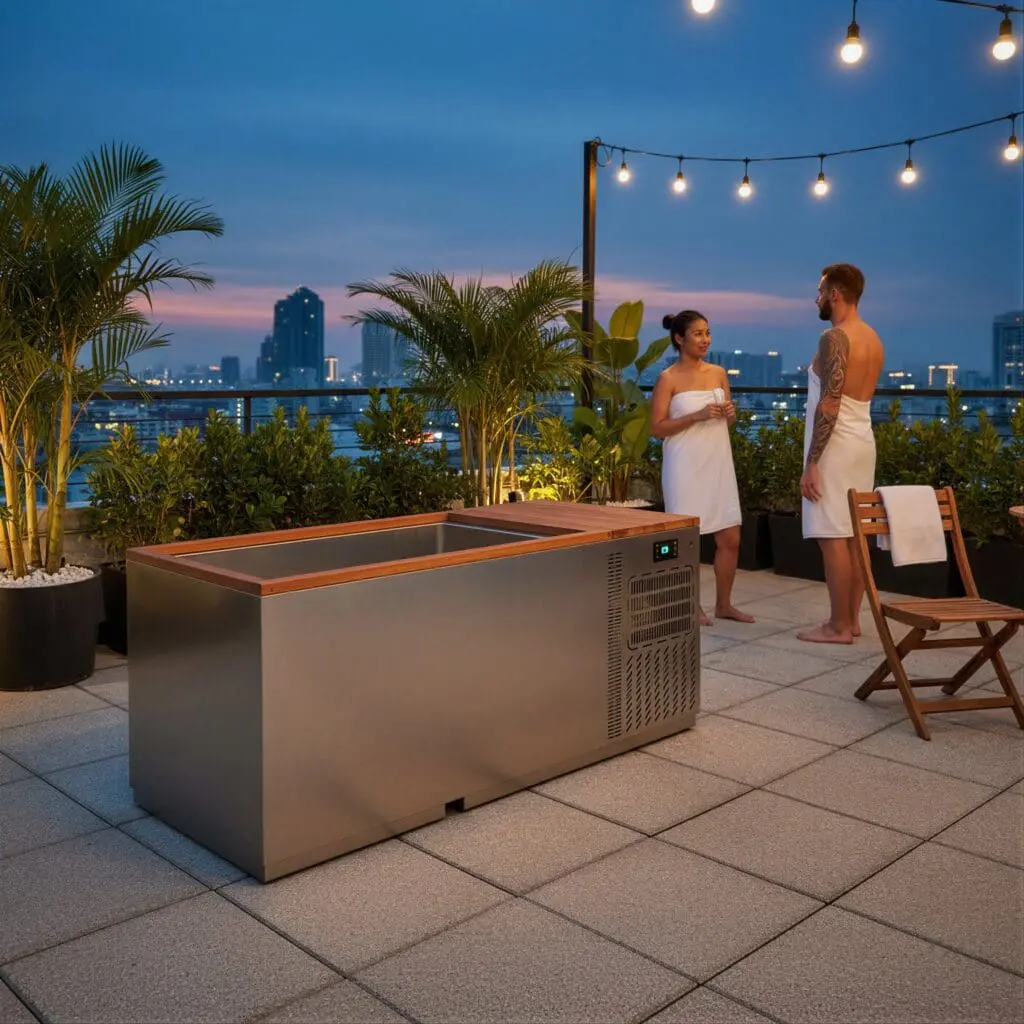
All-in-one ice baths combine the tub, chiller and filtration system into one unit. Just plug it in, use cold water, and that’s that. The convenience is genuine, and for a while it does seem like the sensible choice.
The problem appears after two or three years. The chiller is the hardest-working element in any ice bath arrangement, particularly in this case since it has to cope with 30°C ambient water and 35°C air. With an all-in-one unit, if the chiller fails, you end up having to service a sealed, proprietary unit rather than simply replacing a standard component. The sizes cannot be changed, and the tubs are generally made of plastic composite; if the brand’s support in Thailand is poor, then the entire system is only as good as its worst component.
The verdict is that it’s convenient until the compressor has a bad day.
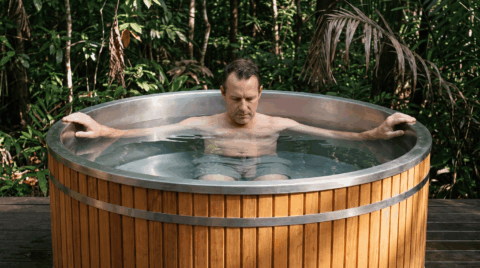
Why are wood and stainless steel ice baths the best for use in Thailand?
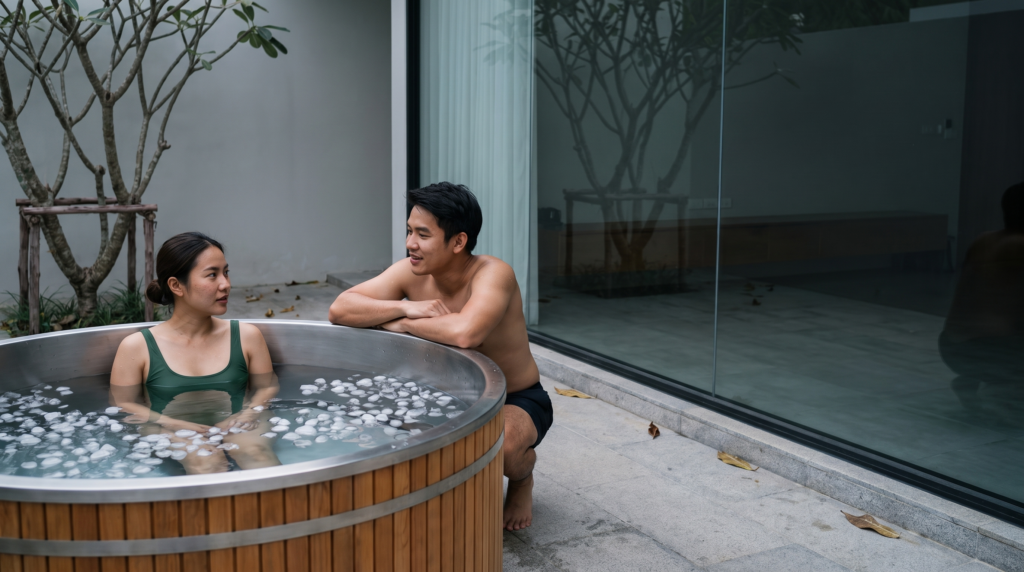
We are the ones who build this kind, so you can take the bias as given. There are solid reasons the combination of wood and stainless steel is the better choice in this climate, and they’re the same reasons that led us to make our selection.
The interior is made from 304 or 316 stainless steel; stainless steel doesn’t scratch into biofilm traps, doesn’t yellow and is unaffected by UV exposure, meaning it can be easily cleaned. In a hot climate, water hygiene is everything, and steel is the simplest surface to keep safe. When you are close to the coast, 316 provides additional corrosion resistance so as to cope with salt air.
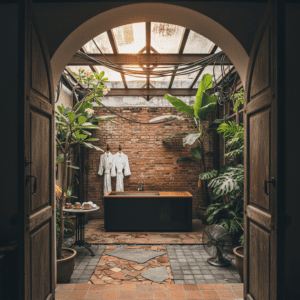
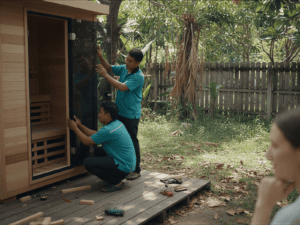
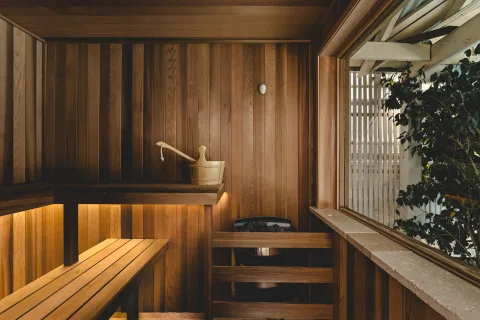
The outside material is either timber, red cedar or thermo pine, and the wood does not come into contact with the water. It is applied as cladding to the steel structure, which allows you to enjoy the warmth of timber without having to endure the difficult maintenance that comes with wet wood. Since both types of timber cope well with the humidity found in Thailand, they are also used in our saunas.
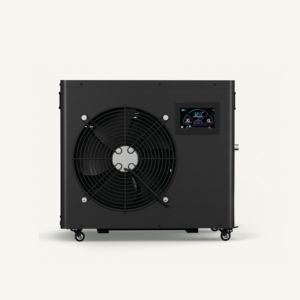
The chiller is a separate component, and it is exactly this aspect that is often undervalued. A standalone chiller is a standard, satisfactory and replaceable unit, and when it finally requires servicing—which happens to every chiller in Thailand—you can have one part serviced or replaced while the bath continues to function for many decades.
It’s built to your measurements. Our custom ice baths are made to order, either circular or oval, and are sized according to the space you have rather than to a shipping container, with a starting price of ฿79,000 and free delivery all over Thailand. This is important for resorts and wellness studios that have a particular footprint, as well as for houses where the bath is on display rather than kept behind the shed.
The verdict is that it has the highest initial cost, the lowest annual cost, and is the only one that improves in appearance with age.
So, which one should you buy?
If you’re having a trial run with it, then buy the inflatable one and a couple of bags of ice as well; there’s no embarrassment in doing that, because that’s the way I would start again.
When the intention is to go indoors at a gym, and the budget is limited, acrylic will suffice.
If you want to have cold water every day for the next ten years outdoors in this climate, then you should get a stainless-steel interior, a timber exterior and a separate chiller; this setup takes Thailand’s heat, sun and humidity into account as design factors rather than treating them as unexpected problems.
FREQUENTLY ASKED QUESTIONS
Q: Do I have to use a chiller when preparing an ice bath in Thailand?
A: Yes, in practice. The tap water here is always between 28 and 30°C, which means that if you don’t have a chiller, you’ll have to buy a bag of ice for each session. The advantage of a chiller is that it keeps the water at your desired temperature continuously.
Q: What is better, 304 or 316 stainless steel, for use in an ice bath?
A: 304 is the standard grade and is well suited for use in inland Thailand; 316 has better corrosion resistance and is therefore the preferable option in coastal areas since salt air corrodes metal. We use both of them.
Q: Can a wooden ice bath rust in Thailand’s humidity?
A: Not like ours, since the timber is used only as external cladding over a sealed stainless steel container and so doesn’t end up in water; both red cedar and thermo pine tolerate tropical humidity very well.
Q: How long does an inflatable ice bath last?
A: Kept shaded and cleaned regularly, a few years. Left in direct Thai sun, considerably less. They are an entry point, not a long-term fixture.
Q: Are all-in-one ice baths a bad idea?
A: Not bad, just a trade. You gain plug-and-play convenience but lose serviceability. When the built-in chiller wears out, you are repairing a proprietary sealed system instead of swapping a standard chiller.