
Most companies in this industry won’t tell you the price up front.
You’ll usually see a nice photo, some words about wellness, and a button asking you to contact them for a quote. In other words, they want to know your budget before sharing the price.
So here are the real numbers for three sizes and two types of timber, plus the two costs people often leave out until you’ve made your decision.
How much does a sauna cost in Thailand?
Between ฿238,299 and ฿886,577 for an outdoor cabin, depending on size and timber.
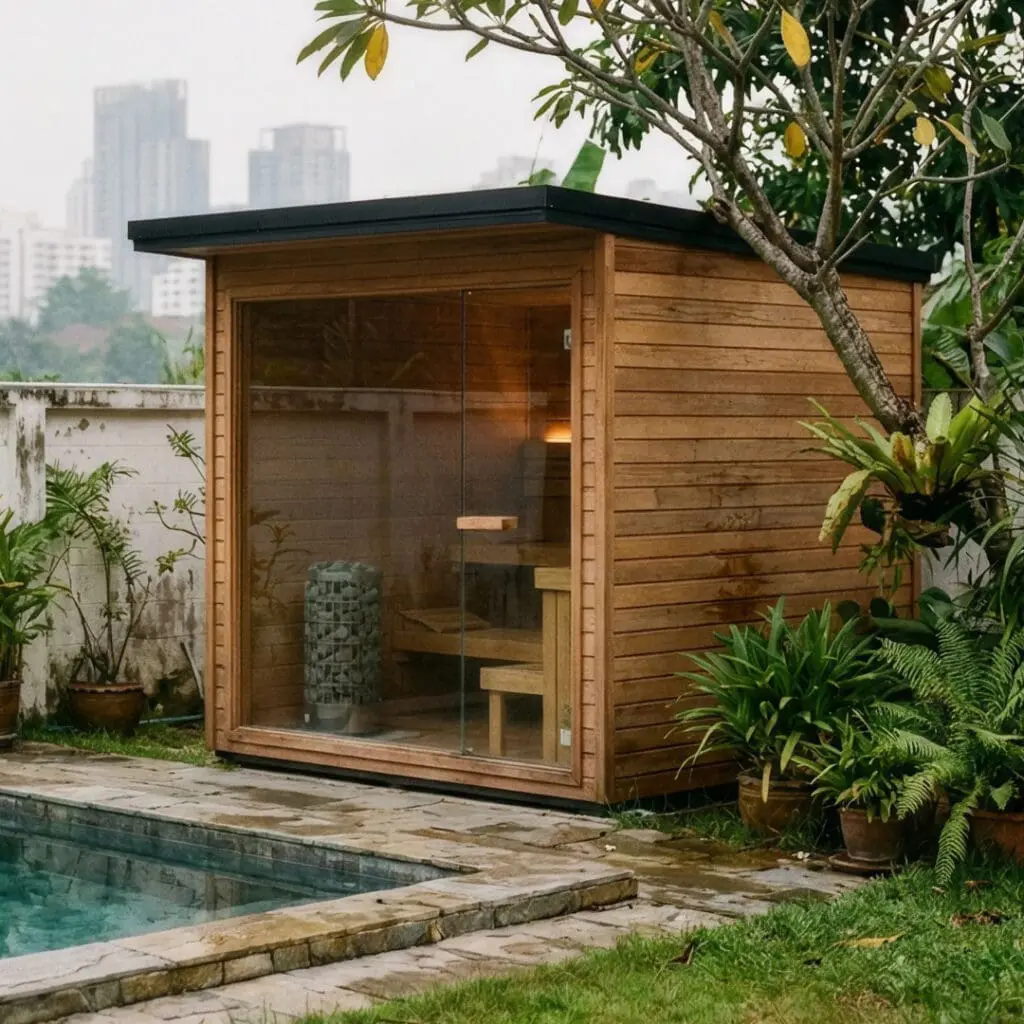
Here’s the real grid. These are outdoor saunas that include a traditional stone heater.
1–2 person · 1600 × 1600mm · 4.5 kW heater
Thermo Pine — ฿238,299
Red Cedar — ฿372,806
6 person · 3000 × 2000mm · 9 kW heater
Thermo Pine — ฿342,600
Red Cedar — ฿542,646
12 person · 5000 × 2600mm · 16.5 kW heater
Thermo Pine — ฿549,167
Red Cedar — ฿886,577
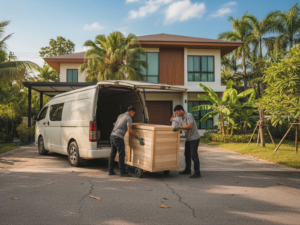
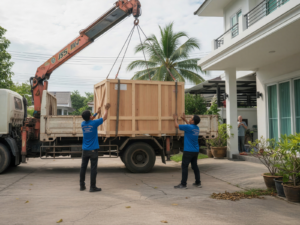
Delivery is free anywhere in Thailand. Installation costs extra, and if you live on an island, ferry charges are separate too.
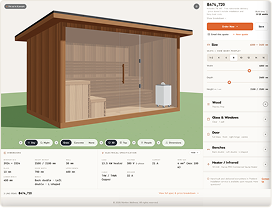
You can use our sauna builder to customise any of these options and see the price change as you go. There’s no hidden price or lead form—what you see is what you pay.
What moves the number most?
Size matters most, followed by the type of timber. Other factors have a much smaller impact on the price.
Size. A 1–2-person cabin and a 12-person room are completely different products. The larger one needs more timber, a bigger heater, and a much higher electrical capacity.
Timber. Many people underestimate how much this affects the price. Thermo Pine comes standard in all the prices above. Japanese Cedar and Red Cedar are upgrades, and Red Cedar especially adds a lot—it’s ฿134,507 more for the small cabin and over ฿337,000 extra for the twelve-seater. The cost increases with size because you need more wood.
Indoor or outdoor. An outdoor sauna is a full building with a roof and weatherproofing. An indoor sauna is just a room. The prices listed above are for outdoor saunas.
BarrBarrel or cube. You can choose either of these shapes instead of the standard cabin. Barrel saunas use less timber for the same space inside and heat up faster, so it’s not just about looks—it’s more efficient. Glass, benching, black exterior. Real, but they move the number by thousands, not hundreds of thousands.
Is Red Cedar worth ฿134,000 more?
Sometimes. It really depends on whether you’ll be looking at your sauna often.
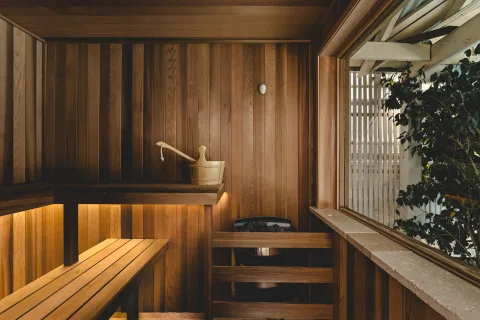
Red Cedar is the best timber in the range. It smells extraordinary when it’s hot; it ages beautifully; it’s naturally durable, and it’s the thing people picture when they picture a sauna.
For a small cabin, Red Cedar adds more than half the price of the sauna itself.
The honest split, as we see it:
Red Cedar is a good choice if your sauna will be a main feature in your garden, if you’ll see it every day from your house, or if you want that special scent. It’s a thoughtful purchase, and it shows.
Thermo Pine is a smart choice if you see your sauna as a tool. It’s not a lesser material—it’s thermally treated, stable, and built to last. When you’re relaxing in an 85°C Thermo Pine cabin, you won’t be wishing for cedar.
Japanese Cedar sits between them and costs a fraction of the Red Cedar jump.
If you’re on a budget, spend more on size rather than timber. A larger Thermo Pine sauna is always better than a smaller cedar one, especially if you want to use it with friends or family. Included?
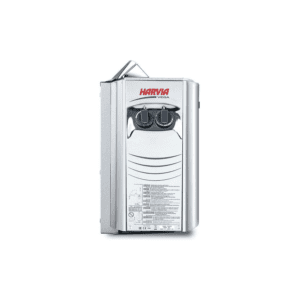
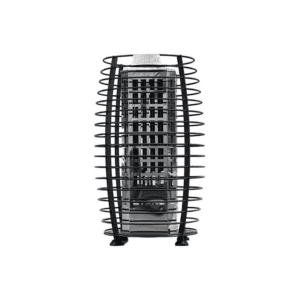
Yes. A traditional stone heater comes with each sauna. The heater included with each sauna is matched to the room size—4.5 kW for the small cabin, 9 kW for the six-seater, and 16.5 kW for the twelve-person model. The room size determines the heater, not the other way around. Don’t pick the heater; the room picks it.
You can upgrade within the range, and the builder shows what that costs. You can also switch the whole thing to infrared rather than traditional.
Controls are included as well. Every sauna comes with a wall-mounted touchscreen, and you can add WiFi app control for iOS and Android if you want. This is especially useful if your sauna is outdoors and you want it hot when you arrive home.
What does installation cost?
Between ฿10,000 and ฿45,000, depending on where you are.
The installation cost depends on your location, not the sauna itself. Installing one nearby is much easier than delivering to an island, where ferry costs are extra.
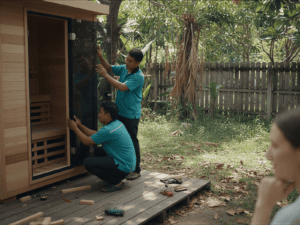
Delivery is free throughout Thailand. Installation is optional and costs extra—the sauna arrives flat-packed and is designed for easy assembly. Many customers put theirs together over a weekend.
So installation is a genuine choice: a Saturday, or ฿10,000 to ฿45,000. Both are fine answers.
What are the two costs nobody mentions?
The base and the electrician. Neither is ours, and neither is optional.
This is where quotes often fall short, which is why the sauna price is never the full amount you’ll pay.
The base. Your sauna needs a flat, strong surface like a concrete slab, a sturdy deck, or paving on a solid foundation. We don’t build the base—your builder handles that. The cost depends on what you already have. If there’s an existing slab, it’s free. If it’s just a patch of soft garden, it will take more work.
The electrician. A licensed electrician will need to install a properly rated circuit for the heater, with its own breaker. We don’t handle electrical work. Every sauna in our builder shows the exact electrical requirements—load, voltage, current, wire size, and breaker—so you can give these details to your electrician and get an accurate quote before you order.
No one can give you a price for the base or electrical work without seeing your site, and that includes us. If someone tells you the sauna price is the total cost, they’re not being honest.
Get quotes for both the base and the electrical work before you order. That way, you’ll have a clear budget instead of an unexpected bill.
What does it cost to run?
It costs about ฿30 per session to run a mid-sized cabin. This is probably the least important number in the whole guide.
Rough arithmetic at around ฿5 per kWh: a 9 kW heater, 45 minutes to heat plus an hour’s use, is roughly 6 kWh once the thermostat starts cycling the element off. Call it ฿30.
Four times a week is about ฿520 a month. Thai residential electricity is subject to a progressive tariff, so your rate depends on your total consumption. Check the bill if it matters.
No one has ever skipped buying a sauna because of ฿520 in monthly running costs.
What’s the cheapest way to get a sauna in Thailand?
The cheapest option is a small Thermo Pine cabin that you assemble yourself on a base you already have. That’s ฿238,299 and a day’s work.
If price is the binding constraint, that’s the answer, and it’s a proper sauna — not a compromise, not a tent, not a heated cupboard. Thermo Pine is a real timber. A compact cabin heats faster and costs less to run. An existing slab or deck is free.
We don’t recommend choosing a sauna that’s too small for your needs. A 1–2 person cabin really fits one person, or two people who are comfortable together. If you want to use the sauna with your family, the six-seater at ฿342,600 is the minimum size we suggest.
How long until you have it?
Six to nine weeks to build, then a day to install.
Every sauna is made to order and built by hand, so the timeline starts when you place your order. Those weeks are just right for getting your base poured and cured and having the electrical circuit installed. That’s why we mention both from the start.
Every sauna comes with a two-year structural warranty, and your deposit is refundable up to 14 days.
What we’d tell you to do
Use our sauna builder to design your sauna, then take the electrical specifications to an electrician before you place your order.
The builder provides the exact load, voltage, current, wire size, and breaker for your chosen setup. It only takes a five-minute chat with an electrician to find out if the sauna you’ve designed will work in your home.
Then get your base quoted. Then order.
If you follow this order, your price will stay accurate. If you do it the other way around, you might end up with a sauna you can’t power or install.
We’re in Ban Suan, ten minutes from Central Chonburi, and you can come and see the saunas by appointment before you spend anything.
FAQ
How much does a sauna cost in Thailand?
An outdoor RönYen sauna runs from ฿238,299 for a 1–2-person Thermo Pine cabin to ฿886,577 for a twelve-person room in Red Cedar. A six-person cabin is ฿342,600 in Thermo Pine or ฿542,646 in Red Cedar. Delivery is free nationwide.
Is the heater included in the sauna price?
Yes. A traditional stone heater sized for the cabin is included, along with a wall-mounted touchscreen controller. WiFi app control is an add-on, and you can upgrade the heater or switch to infrared.
How much more does Red Cedar cost than Thermo Pine?
It scales with the build. Red Cedar adds about ฿134,500 to a 1–2-person cabin, ฿200,000 to a six-person cabin, and over ฿337,000 to a twelve-person. Thermo Pine is included in the base price.
Is delivery free for saunas in Thailand?
Yes, delivery is free nationwide. Installation is charged separately, ranging from ฿10,000 to ฿45,000 depending on location, and ferry costs apply to islands. Installation is optional — the sauna is flat-packed and can be self-assembled.
What extra costs are there beyond the sauna price?
The base and the electrical. RönYen doesn’t do groundwork or electrical work, so a builder prepares the base and a licensed electrician runs the circuit. The sauna builder gives you the exact electrical spec to hand to your sparky.
What’s the cheapest sauna?
A 1–2-person Thermo Pine cabin at ฿238,299, self-assembled on a base you already have. Thermo Pine is real timber, not a compromise. If you want to sauna with family, the six-person sauna at ฿342,600 is the honest floor.