
The first time I saw a sauna fall apart in Thailand, it was only three years old. The bench tops had warped like surfboards, the wall joints had opened enough to let in daylight, and termites were quietly making their way up one corner. The owner had bought it based on a European spec sheet, using beautiful Canadian cedar and solid construction, and assumed it would perform the same in Bangkok as it did in Helsinki.
It didn’t. Thailand is different from Finland. Heat, humidity, termites, monsoon mould, and strong sunlight break down wood that would last for decades in a colder place. If you choose the wrong wood, you’ll be rebuilding in five to seven years. Choose the right wood, and the tropical climate is barely a problem.
Here’s what I’ve learned after years of selling, installing, and seeing how customers’ saunas and ice baths age in Thailand. I’ll cover what lasts, what doesn’t, and the timber options we offer at RonYen for tropical conditions.
What makes wood good for a sauna in Thailand’s climate?
A sauna anywhere needs wood that can withstand three conditions: extreme heat, repeated wet-and-dry cycles, and direct skin contact. In Thailand, you have to add four more: constant humidity, monsoon season, termites that quickly eat softwoods, and months of strong sunlight that bleaches and dries anything outdoors.
The properties that matter most:
Dimensional stability: the wood needs to stay flat as it moves between hot, dry sauna conditions and Thailand’s humid air. Some types of wood are naturally more stable than others.
Low resin and sap content: heated wood releases sap. Pine or untreated fir in a sauna will drip sticky resin onto your skin and benches. Saunas need wood with naturally low sap content, or wood with sap removed.
Low thermal conductivity: this is why a 90°C bench doesn’t burn you. The wood needs to insulate against its own heat. Some types warm up slowly, while others get hot quickly.
Rot and decay resistance: repeated moisture exposure means that any wood susceptible to fungal damage will eventually fail. In Thailand’s humidity, that risk is always present, not just during certain seasons.
Termite and insect resistance: this is something most guides from colder countries don’t mention. Termites in Thailand quickly eat untreated softwood. Some woods naturally repel them, others need treatment, and some are basically termite food.
Which sauna timber options does RonYen offer?
Our saunas are available in a range of timbers selected for tropical performance. Each has its own strengths, and the right choice depends on budget, look, and where the sauna is headed.
Red Cedar
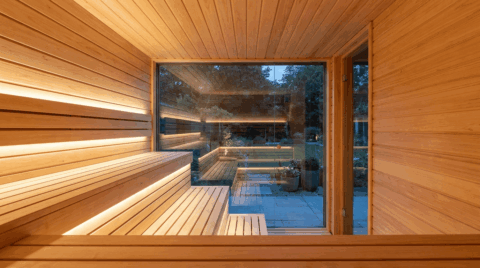
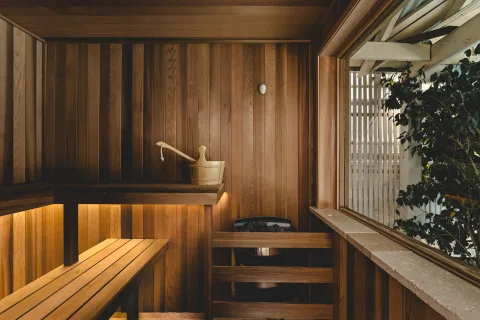
The premium classic. Naturally aromatic, low-resin, very dimensionally stable, naturally rot- and insect-resistant. It’s lightweight and doesn’t transfer heat aggressively. The smell is a big part of the experience for many people. Rich reddish-brown with striking natural grain. The benchmark sauna timber and what we recommend when the budget allows.
Rusty Cedar
Milled from high-quality knotty cedar. It has the same natural resistance to rot and insects as Red Cedar, but with a more unique look, featuring rich grain and distinctive knots. It looks warmer and more textured than clear cedar. It’s a great choice for anyone who wants a natural character in their sauna.
Japanese Hinoki
A refined timber with warm golden tones and subtle light purple streaks. Naturally rot and insect resistant. It has long been used in Japanese construction and fine furniture for its durability and distinctive scent. Sits between Red Cedar and the budget options in terms of price.
Japanese Cedar
Straight, uniform grain with a naturally pleasant fragrance. Its anti-corrosion and insect-resistant properties make it well-suited for outdoor builds. Light-to-medium dark colouring that closely resembles Canadian Red Cedar at a different price point. A solid mid-range option.
Thermo Hemlock
Hemlock that’s been heat-treated to deepen its colour to a cedar-like tone and greatly improve its performance. The heat treatment closes the moisture-absorbing cells in the wood, which is ideal when the humidity is around 70% all year. After treatment, it resists corrosion and insects. It’s the best value for this climate.
Hemlock
Untreated hemlock. Pale, neutral, low resin, light colour with few knots. Looks high-end and clean. For outdoor use, we generally recommend timber oil and protective shingles to extend service life. Best suited to indoor builds or covered outdoor positions.
Thermo Pine
Heat-treated pine is the budget thermo option. The heat treatment gives it a darker colour and makes it resistant to corrosion and insects. It has a knotty look. It’s better than untreated pine for outdoor and humid conditions.
Source: International ThermoWood Association — Properties of Thermally Modified Timber
https://thermowood.fi/thermowood-process/
What’s the best sauna wood for Thailand specifically?
For Thailand, my honest ranking based on what actually holds up:
- Canadian Red Cedar or Canadian Rusty Cedar are the top choices if your budget allows. They naturally resist everything the Thai climate throws at them. With their iconic smell, beautiful grain, and good ventilation, they can last for decades even in Thailand.
- Canadian Thermo Hemlock is the best value for this climate. Heat treatment stabilises the wood and keeps termites and fungus away. It costs less than cedar but performs almost as well in tropical conditions.
- Japanese Hinoki, or Japanese Cedar, is a true premium alternative to Canadian cedar, each with its own unique character. They naturally resist rot and insects. These are good options for anyone looking for something different.
- Sweden/Finland Thermo Pine is the budget thermo option. It works better than untreated softwood and is affordable for first-time sauna buyers.
- Canadian Hemlock is fine for indoor saunas or well-covered outdoor spots, but I wouldn’t use it for outdoor builds exposed to full Thai weather unless you add protection.
It’s best to avoid using untreated pine, untreated fir, or any softwood that hasn’t been kiln-dried or heat-treated for sauna interiors. These woods can leak resin, change shape, and rot, so they aren’t worth the savings.
What about teak — isn’t it the best wood for the tropics?
Teak is a common topic. People often think of it when they want wood that lasts in the tropics, and that’s understandable. Outdoor furniture, boat decks, and pool areas have used teak for centuries because it handles humidity, salt, and sun better than most wood. So it’s a fair question.
The issue with teak in a sauna is comfort. It’s a dense hardwood, much harder than cedar, hemlock, pine, or hinoki. Sitting on a teak bench at 90°C for twenty minutes is much less comfortable than sitting on a cedar or heat-treated softwood bench, which has more give and doesn’t get as hot. Teak also transfers heat more quickly than softwood, so the bench surface gets hotter where your skin touches it. That’s not what you want in a sauna.
The softwoods we use, especially cedar, are the industry standard for sauna interiors around the world; for this reason, not just in Thailand. Once you sit on a well-made cedar bench, you’ll see why teak hasn’t replaced it, even with all of teak’s other strengths.
So our view on teak is simple: it’s a great wood for outdoor decking, pool areas, garden furniture, and ice bath cladding if you want that look. But it’s not the right choice for sitting in a sauna. We don’t use it in our sauna range and wouldn’t recommend it, no matter who is building the sauna.
Why are ice baths made of different materials than saunas?
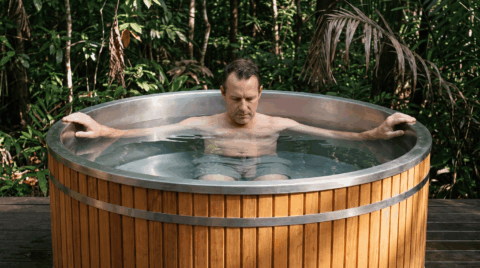
This is where most articles go wrong. Modern ice baths separate the water-holding part from the decorative exterior. The water sits in a stainless steel or composite inner liner. The wood on the outside is just cladding and never comes into contact with water.
That separation matters because it solves a problem traditional all-wood ice baths can’t. Untreated timber that sits in water, drains, refills, and sits in water again will eventually degrade. It warps. It develops mould. Wood is porous, which means bacteria establish in it over time, and you can’t sterilise it properly between uses. In Thailand’s ambient humidity, that process is accelerated significantly.
Stainless steel solves all those problems. Specifically, 304-grade or 316-grade food-safe stainless. It doesn’t absorb water, warp, or develop the biofilm that makes wooden tubs hard to keep clean, and it can be properly sanitised. The wood on the outside gives you a warm look and character, but it never comes into contact with water.
Which ice bath construction does RonYen offer?
Three main configurations in the current range:
Red Cedar exterior with stainless steel interior
The premium classic. Canadian Red Cedar staves on the outside, with a 304 or 316-grade stainless inner tub. You get the visual warmth and natural character of cedar without any of the structural problems wood would face if it were in contact with water. The cedar is naturally rot-resistant and ages well in the climate. The stainless interior is non-porous, easy to clean, and corrosion-resistant. This is what most residential customers choose.
Full stainless steel
It has a clean, industrial finish and is the easiest and most hygienic option to maintain. You can choose a polished or matte black-coated exterior. This style works well in commercial settings such as clinics, gyms, and hotels, as well as in modern homes where a minimalist look fits the design. It’s easier to clean and inspect, and it lasts longer with heavy use.
Composite wood
You get the look of wood without the maintenance. It is weather-resistant and keeps its colour and texture without the regular oiling that real cedar needs. It’s a good choice for outdoor spots in full sun or for anyone who wants the wood look but not the upkeep.
The one setup we don’t offer, and never will, is plain unlined wood touching the water. There’s a reason for that. It doesn’t work well in this climate, and the hygiene trade-off isn’t worth the rustic look.
What’s the best ice bath construction for Thailand?
For most homeowners, a Red Cedar exterior with a stainless steel interior is the best choice. You get the look of wood, cedar stands up well to Thailand’s humidity, and the stainless steel interior helps you avoid the hygiene issues that come with wood and water.
For commercial use — gyms, recovery clinics, hotels — full stainless steel makes more sense. Higher hygiene standards, harder use, more cleaning. Stainless takes that without complaint.
For outdoor spots in full sun, where cedar would dry out and fade too quickly, composite wood is the lower-maintenance option. It keeps its appearance without needing oil.
How do you care for wooden saunas and cedar ice baths in tropical climates?
Maintenance is where many owners make mistakes. A wooden sauna in Helsinki needs almost no care, but in Bangkok, it does. Here’s what really matters:
Ventilate between sessions. Leave the sauna door a bit open and prop up the ice bath cover after each use. Warm, moist air that becomes trapped allows mould to grow. Five minutes of fresh air does more than any chemical treatment.
UV protection for outdoor builds. Direct sunlight bleaches wood quickly in Thailand. Adding a roof, cover, or shade extends the wood’s lifespan. Oils and stains help, but they can’t replace keeping the harsh sun off the wood. For any outdoor wooden structure, a termite barrier or chemical treatment at the installation stage is cheap insurance. Done early, it lasts for years. Trying to retrofit one after termites are already in is far harder.
Use timber oil on cedar every six to twelve months to keep its color. If you skip this, the cedar will turn silver, which is fine if you like that look. The wood won’t break down either way; oiling is just for appearance.
Don’t use heavy chemical sealants on sauna interiors. Varnishes and polyurethanes can release fumes in the heat and become sticky. Sauna wood interiors should be left raw or finished only with food-grade sauna products.
FAQ
Q: What’s the best wood for a sauna in Thailand?
A: Canadian Red Cedar is the top choice. It naturally resists rot and insects, stays stable, and handles tropical humidity well. Canadian Thermo Hemlock is the best value, with heat treatment that closes the wood’s moisture-absorbing cells. Both are better than untreated softwoods like pine or hemlock in Thailand’s humidity.
Q: Do RonYen ice baths use solid timber?
A: No. Our ice baths use a stainless steel or composite inner liner — that’s what holds the water — with optional Red Cedar exterior cladding for the timber look. Solid all-wood ice baths are problematic in Thailand’s climate because untreated timber in contact with water absorbs moisture, develops mould, and cannot be properly sanitised between sessions.
Q: How long does a wooden sauna last in Thailand?
A: Properly chosen and maintained, fifteen to twenty-five years for the core structure. The wrong wood or poor maintenance can drop that to five to eight years. Ventilation, UV protection, and termite prevention make the biggest difference.
Q: Do I need to oil or seal sauna wood?
A: Sauna interiors should generally be left raw or treated only with food-grade sauna-specific products. Conventional varnishes and polyurethanes can off-gas at high temperatures and become tacky. Outdoor sauna exteriors can benefit from periodic UV-protective oils.
Q: What about teak — isn’t it the best wood for tropical conditions?
A: Teak is excellent for outdoor furniture, decking and marine use — extremely durable in tropical humidity. For sauna interiors specifically, though, teak is too hard and conducts heat too aggressively to be comfortable to sit on for a full session. Softwoods like cedar and thermo-treated hemlock or pine have the natural give and lower thermal conductivity that make long sauna sessions comfortable, which is why they’re the industry standard worldwide. We don’t offer teak in the sauna range for this reason.
Q: What’s the cheapest sauna wood that still holds up in Thailand?
A: Sweden/Finland Thermo Pine or Canadian Thermo Hemlock. Both are heat-treated, which gives them anti-corrosion and insect-resistant properties at a much lower price point than cedar. Untreated hemlock is cheaper still, but lasts noticeably less time in Thai outdoor conditions.